Engels
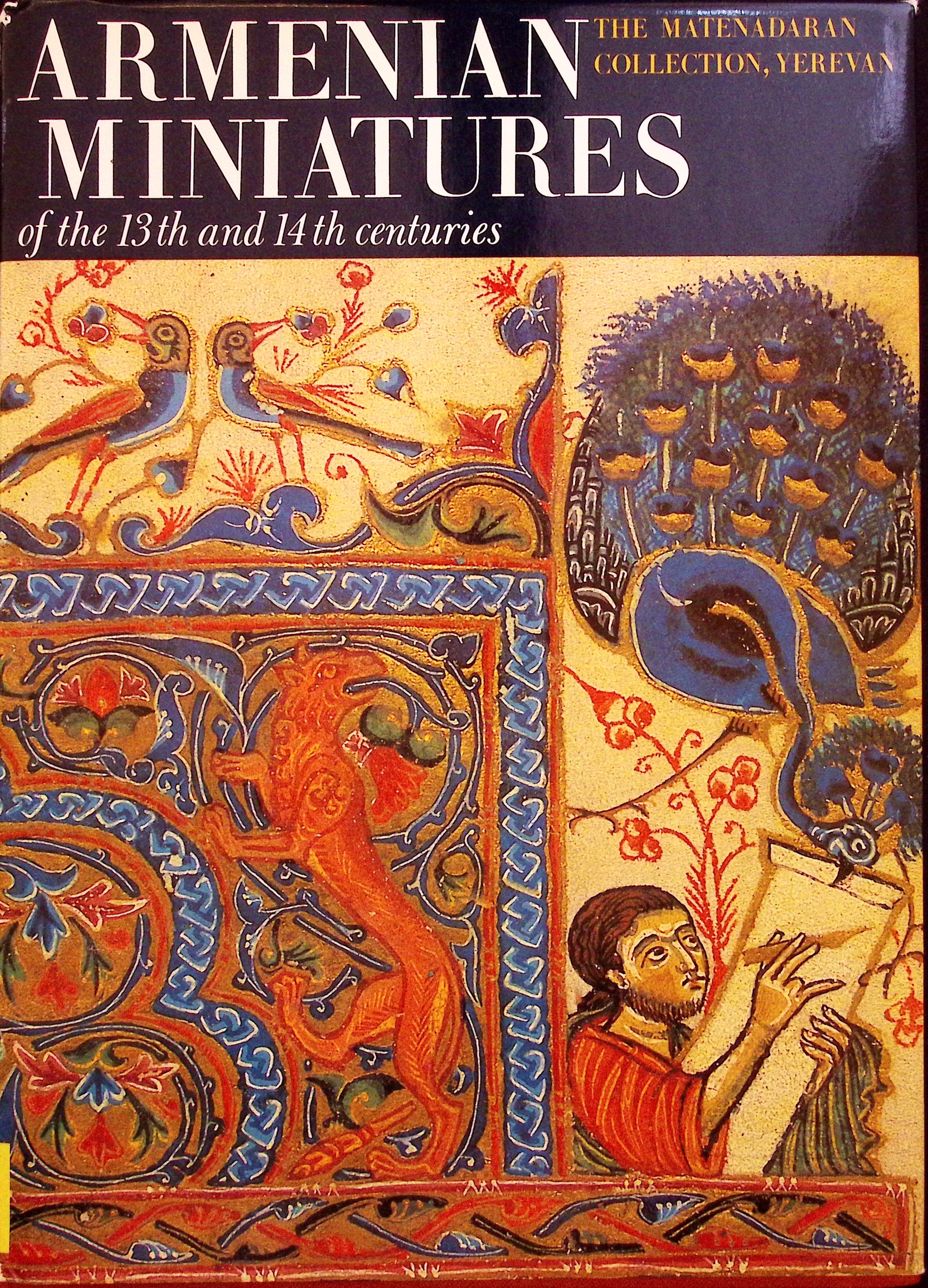
Armenian miniatures of the 13th and 14th centuries (from the Matenadaran Collection, Yerevan)
Korkhmazian, Emma; Drampian, Irina; Hakopian, Gravard • Kunst
1984 , Leningrad (ART KORE 1984)
Despite all the cataclysms of its dramatic history, despite the disastrous wars in which Armenia rose up in arms against its enemies, no matter how strong they were, the Armenian people remained faithful to the traditions of their national culture which they never ceased to enrich and develop. That is why Armenian soil abounds in artistic and cultural wealth, that is why to this day one admires its numerous architectural monuments in which excellent building technique is combined with the beauty of wall reliefs and frescoes, its unique khatchkars covered with exquisite carving, its beautiful examples of decorative arts, and, finally, its famous miniatures that reflect the highest achievements of medieval Armenian painting.
Unfortunately, due to Armenia's turbulent history, many of the cultural monuments created by the Armenian people were destroyed or plundered and have not reached us in their original beauty. But while wall reliefs and frescoes often perished in the course of wars or natural disasters, illuminated manuscript could be hidden from the enemy or saved from the ruinous forces of nature. Consequently, we can now speak of a fairly large and representative collection of old Armenian manuscripts. Thus, in Yerevan, in the Matenadaran manuscript library bearing the name of Mesrop Mashtots, the inventor of the Armenian alphabet, there are about fifteen thousand Armenian manuscripts, complete or fragmentary. These manuscripts originated from many different religious and cultural centres which existed in Armenia and also, in certain historical periods, in Armenian sattelments outside the country. About a thousand and a half such centres are known to have existed in Armenia alone.
Ook online
PDF bekijken